Discover The Starflower: Now in Audiobook on Audible, iTunes, and Amazon

Austin Macauley Publishers informs me that The Starflower is now available in audio format on Audible, iTunes, and Amazon.

The reader learns of this far future universe and all its colorful details through the eyes of Gayle Zimmon, a young woman who grows up on a remote planet barely more aware of aliens, AI, and genetically engineered humans than she is of walking in heels. The story unfolds for the reader as it does for ‘Zim’. This week The Starflower received another 5-Star Amazon review:

Worldbuilding at its Finest

January 28, 2025. The Starflower is an exciting adventure with the philosophical undertones that great science fiction is known for. Zim is a spectacular female hero. She is tough and insightful. It is a spy novel, political thriller, and futuristic fantasy, all tinged with a bit of magic (the prophecy). I hope there is a sequel. I would follow Zim anywhere!

Xanadu Books Interview

I enjoy interviews (hint to any readers in that business) and had fun working with Xanadu Book Awards & Press. Their approach concentrates on a writer’s motivation and personal resources. To my experience, writers can be very different. Especially creative writers who think outside the formula.

More Truth Said in Fiction

I am often asked how a technical analyst (42 years in intelligence) came to write speculative fiction, and sci-fi in particular. I touch on this in the blog description: “More truth is said in fiction.” And watching a Jack Reacher movie a few months ago, I heard a similar comment from a defector: “Fiction has to make sense, intelligence does not.”

Many authors have chosen to couch serious societal comments in fantasy and fiction worlds. Mary Shelley’s Frankenstein expressed concern that scientists caught up in research would fail to consider its consequences. Kurt Vonnegut’s Cat’s Cradle expressed similar concern, and Player Piano projected an automated world that crowded out human labor. In Gulliver’s Travels, Jonathan Swift casts his societal satire in fantasy/SF worlds of miniature humans, giants, intelligent horses, and detached intellectuals floating about in a city in the sky. Consider Orwell’s Nineteen Eighty-Four and Animal Farm, both of which had trouble finding publishers because, as he was told, Joseph Stalin might be offended.

These and similar stories might be read for light escapism. The authors understood that in their time many were not ready to grasp their stories’ deeper implications. I suggest that their choice of fantasy and SF settings has much to do with these stories still being read today.   

A Five Star Review of The Starflower, 13 September, 2024.

This was a vibrant story about the universe in the distant future…I believe a year that was mentioned was 3569 but that was at least a few years before this story takes place. A young military woman, The Starflower, became a hero to humans and many other alien species alike after numerous successful battles against the Aldrakin species that was waging war on many planets unable to fend for themselves. After a surprise attack that she strategically won subsequently ending the war, she is faced with jealousy from the Star Command back home. She may have ended the war, but the true enemy was still at large and had it’s targets set on her and her lover. 

I was a little confused at the start of the book because it drops you straight into an immersive new world. I was able to easily find my way out of that confusion within the first few chapters and really got drawn into the story. The author was really able to make you imagine how these new worlds and alien species look and act. I found it absolutely fascinating. This is the best sci-fi book I’ve read in a while. Also as an editor I found very few errors so it was a nice clean read I could enjoy.

Five Star Reviews

Not all the reviews have been five-star, which is understandable in an epic story that lays out an entirely new universe. And some readers prefer cozy, warm stories. Zim preferred that sort of life, too. She didn’t get it.

Thrilling SciFi Fantasy with incredible worlds to discover Reviewed in the United States on September 7, 2024

The overarching themes of this book are somewhat reminiscent of Gattaca (in its take on Eugenics and how it might affect human hierarchy) and also of Dune (in its prophetic ideas of a single person to unite and fight for the less fortunate). Nevertheless, this story takes a unique approach to both of these themes. The main character “Zim” (callsign “StarFlower”) is both endearing and realistic. She is thrust into a prophecy when she least expects it, and all that ensues is both exciting and terrifying. The characters are very enjoyable in their depth, and I enjoyed the vast universe that the author creates. I like the combination of good story telling with so much to unpack that it will surely be a great series!

Aliens Among Us

My short story “Aliens Among Us” will appear in the animal story anthology THE DOG WHO WOOED THE WORLD to be published on 30 May. My point in the story is that sentient ‘alien’ intelligence surrounds us on this planet. My story includes three real alien encounters.

Screenshot

Ever-Endeavor

In the spirit of keeping one’s mind active, I have taken to writing down my ideas and aberrant thoughts. Some of these become stories and some are picked up for publication. My flash fiction piece “Ever-Endeavor”, a look back at life from the beyond, was published yesterday in the online magazine ALTERED REALITY for their Spring edition: https://www.alteredrealitymag.com/ever-endeavor/

God and My Other Responsibilities

Life journeys take many paths, and they cross often. All must answer the same life questions. So though our sojourns differ, those new to the path may benefit from familiar footprints at the intersections.

100_0303

I believe it is difficult to understand those whose skill sets and concerns differ significantly from our own. That is a major reason we see things differently. Depending on the tools we possess, an obstacle for one may be an opportunity for another. If all one has is a hammer, one may never think to use a screw—or a saw. Won’t a board split if we pound it hard enough?

It has become fashionable, even prideful for some, to claim or strive for complete independence in all things. Forcing oneself to struggle in areas of lesser talent, insisting that greater effort is all that is required, keeps one from nurturing their special talent and perhaps using it to benefit others. It also keeps us from recognizing and appreciating the special talents of others. I think that recognition is important for finding partners and building teams, and an important quality for leaders to cultivate.

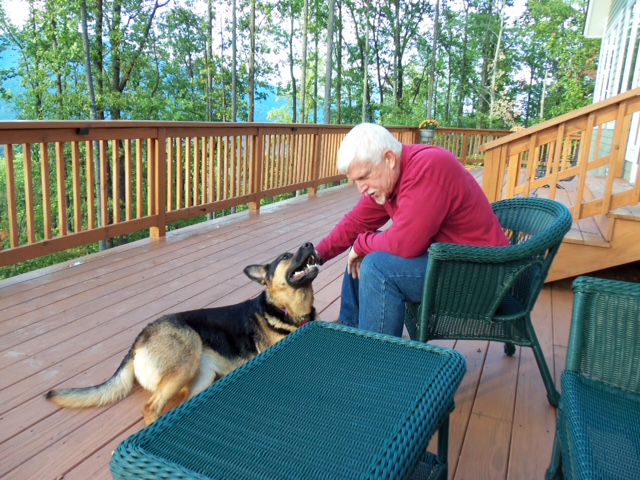
Someone once asked me, “What would it be like to be God, to have God-like power?” My answer was, “I have been God. My dog Freya sees me as all-knowing and all-powerful, the deliverer of all good things, immortal, and invulnerable.” I don’t let that go to my head. When I make the mistake of roughhousing with her—a 110-pound Rottweiler-Shepherd with a lot of sharp edges—she teaches me otherwise.

100_0301

I walk away bloodied, but that doesn’t shake her faith in my perfection. Many have commented on how she follows and seems to worship me. I remember my children when small behaving in much the same way. The mantle of godhood should be taken seriously but worn lightly. As with many pretenses of godhood—PhDs, certified credentials, modern breakthroughs and discoveries—I find little that is new. Discarding ancient wisdom, we rediscover what was long known and, hearing it coming from our mouths, declare it brilliant and extraordinary.

Out of curiosity—a trait I have in abundance—I have tried many things. Except for all the added mysticism, I found Yoga little different from the stretching exercises I learned for wrestling and Tai Kwan Do. The fact that they bring peace and relaxation doesn’t require an advanced degree or expensive class to appreciate.

I met with Maharishi Mahesh Yogi when he toured the country—the same person John Lennon visited in India. His teachings predate “Mindfulness” and were certainly not about voiding the mind. It was all about thinking clearly. Cleeer-leee was how he pronounced it. One clears the mind to filter out the nonsense repeated and shouted at high volume, often with the intent to manipulate and sell everything from happiness to politics and used cars. These claims of new and perfect knowledge cannot stand close examination.

I believe the early Genesis story was intended as a metaphor. Eve died in the perfection of the garden and was born into the life of struggle necessary to survive and grow in an imperfect world. Like mine, her sin was curiosity, wanting to know and understand what was outside the gate. She may have been willing to pay the price for the mistakes she made.

This post was inspired by M. Talmage Moorhead whose post set me to thinking.

The Book of Nathan

“What can you make of this?” The woman pushed the image across Nathan Shipley’s desk. Her soap-scrubbed scent contrasted with his unwashed odor and the mildew of the basement office. Nathan slipped his wire-rimmed spectacles back past his long hair and around his ears, then glanced down at the image. It was a single ideogram retouched to obscure its background, possibly a rubbing from a monument or headstone.

“Can you give me a little context? Where was this taken?” Nathan looked into the woman’s expressionless face. She appeared to be in her early thirties and in excellent physical shape, certainly not an academic. Military, he guessed, although she and the two large men with her wore gray business suits rather than uniforms.

“I’m sorry, Dr. Shipley,” she said. “I’m not permitted to reveal the location. Can you give me anything at all?”

“I’d guess it’s early Mycenaean, a predecessor to Linear A. But you knew that or you wouldn’t have come to me. Did it come off a building, a clay tablet, perhaps a pottery shard? With some context, I might venture an interpretation.”

“You could translate it?” Her eyes suddenly locked on his.

“With a wider sampling, most assuredly.” He feigned confidence, hoping he would get a chance to try. He touched the image. “This ideogram indicates time—the side marks are qualifiers.” The woman leaned in, eyebrows raised. “The leading qualifier negates prior time, the trailing one negates anything coming after.”

“Nothing before and nothing after?” The woman’s pressed palms almost clapped. “Alpha and omega?”

Nathan nodded. “Or infinity. If this came from a palace or a courthouse, it might symbolize final authority.” He scratched behind his hair-thatched ear. “On a tomb, it might indicate that time had lost all meaning.”

“Thank you, Dr. Shipley.” The woman pushed back her chair to stand. Thinking she was leaving, Nathan stood to see her off.

“We need you to come with us, Dr. Shipley.” She waved her two friends forward and whispered to them.

“I should be able to…” The woman grabbed his coat as the two men rushed him out to the waiting limousine. “Wait, my work…” Nathan protested.


Four months later, Nathan found himself on the observation deck of a Global Space Agency research lab far out in space.

“You brought me up here for this?” he asked, staring at the massive, metallic-glass sphere beside the lab. When GSA found it in Earth’s orbit three years earlier, they had keep it a secret—its location, hidden behind the far side of the sun, raised too many questions.

“What do you expect me to tell you?” Nathan asked, raising both hands, palms up. Beside him stood the woman who had kidnapped and accompanied him on the long trip to the space station.

“What it is … How to get inside,” she said, pointing to the sphere. “We’re at a standstill. You know how much money, how many scientists, how many crazy ideas are kicking around?” She looked at Nathan, her face contorted. “We’ve tried blasting, cutting, drilling—not even a dent. The thing just wobbles a bit and heals, like some indestructible bubble. We can’t even do a spectral analysis. We have no idea what sort of technology we are dealing with.”

“I suppose you tried going in the front door?” Nathan asked, tilting his head toward the sphere’s ornately embossed, other-century-style gateway.

“A field appears and blocks the way whenever we approach. Other than that, we’ve found no defenses and have gotten no reactions. Remember the symbol I showed you in your office?”

“The infinity ideograph?”Slide1

“It’s on the panel beside the gateway. You said you wanted context, a wider sampling. We think the panel might be interactive.”

“That’s it?” Nathan asked. “You want me to just walk up and say ‘hi.’” She nodded, lifting her eyebrows sheepishly and smiling.

Sixty minutes later, suited up for a spacewalk, Nathan hooked onto the cable-rail along the two-meter-wide platform connecting the GSA lab to the sphere.

As he approached, a field of white bloomed in the gateway, fluttering like wings of light. Then a clay-tablet-like panel emerged with the impression of the ideograph.

“Infinity,” Nathan murmured as he traced the panel’s symbol with his gloved finger. Another ideograph replaced the first, Who? Beneath it, Nathan clumsily traced an ideograph in the clay for “name” then the numeral six. The sixth day. The wings of light fluttered down. He entered the sphere.

The interior was bright. Gravity pulled Nathan’s feet onto a flat deck covered with living grass. The dome above displayed sunrise in a morning sky filled with drifting, puffy clouds, and a flock of birds, geese, honking like those he had seen as a boy, camping with his uncle up north. A stream-fed pond at the far side of a flowery meadow was nestled among trees, both evergreen and deciduous. Beyond them, hills rolled back to the horizon. Whitetail deer grazed nearby, lifting and lowering their heads.

“You have served your time, child of the sixth day, and may return,” a warm voice said. Nathan looked around for the source but saw no one. The fluttering white field again blocked the gateway. Longing to taste and feel the air, he removed his helmet and took a deep breath.

“Return to where? Where am I?” Nathan asked, feeling the sun warm his face and a breeze rustle his long hair.

“I prepared a special place for you, one with many rooms,” answered the voice.

“Is this a game or for real?” Everything felt, looked, and smelled Earth-like: gravity, atmosphere and terrain, plants and animals, the stream and clouds. More idyllic than Earth-like, Nathan thought as a hummingbird landed on his arm.

“I reach you where you are,” said the voice, “with what your mind is able to grasp. Your technical culture recoils from scrolls and clay tablets, anything not reducible to mathematical code, anything connected to your past. In growing, you have become uprooted. That is why I sent for you, Nathan Shipley.”

“You sent for me?” A chill shot up Nathan’s spine.

“By contacting your culture in the manner I did, I compelled scientists to seek you out and to ask the questions they have long forgotten. I created their paths for discovery long ago, in the stones, in the stars, and life itself—all things great and small. Yet those who followed my well-marked paths took credit only unto themselves, boastfully dismissing questions that would bring deeper understanding.”

“Why me?”

“You seek meaning in all things, not just the arrow pointing to the next arrow further up the path—the arrows I set. Your culture seeks the arrows only so its quiver might be filled.”

“I am just a collector and student of artifacts and ancient wisdom.”

“You are the one who will carry my message to my people,” the voice said softly. Nathan swallowed hard, feeling small and very frightened. The voice continued, “I will come again soon with a greater reality. It is a reality many will fear, for it will come upon them like a storm upon the sea. Others will embrace it. The wind will fill their sails and carry them forward. You must go and tell my people.”

Nathan trembled uncontrollably. “It is too much. I am weak and unworthy.”

“Two gifts I give you, fruit from each of my great trees.” A figure of light came forward with a tray bearing two star-like fruit: one green, one golden.

Nathan started. “But it is forbidden to—”

“Soon all may taste this fruit. They are for your mission.” The figure of light held out the tray and Nathan consumed the fruit. “Now go and tell my people.”

Light dimmed as the sun set beyond the hills. Other lights along the path directed him back to the gateway. The fluttering white field parted like a curtain. He found himself outside on the platform with his helmet in place.

Upon returning, Nathan was surrounded by scientists, engineers, and executives in the GSA main conference room. He had met and spoken with aliens—scientists refused to consider any other explanation. The medical staff found no damage from what the aliens had fed him; indeed, his health was extraordinary. The alien message that Nathan delivered threatened some and cheered others, just as the voice had told him. Most attributed it to post-trauma stress and delusion.

Nathan felt only calm. Cleverly worded legal documents he understood at a glance—even without his glasses, which he no longer required. He knew the tests scientists gave him were intended to twist the message he’d been given.

The next morning, a team prepared to re-enter the sphere. As they approached, the sphere vanished. Everyone at GSA seemed surprised, except Nathan. They decided to wait for its return. Hadn’t the message said, “I will come again?”

Nathan hid a smile. His new discernment told him the return would not be to the far side of the sun. “I must tell your people,” he murmured, remembering the voice and sensing the warm sun on his face.

Both Sides Now

Until I died, I hadn’t noticed I’d been living in a bubble. Aging and death were unknown to me. But looking back I might have seen it coming: the pressure in my chest, losing mobility in my limbs, every movement meeting greater resistance. The tightening increased toward the end. Then came intense pain, in my head, all over my body. My world went into convulsion. Whatever I’d deemed important no longer mattered. Everything shrank down to that single moment in time. When a light appeared above my head, brighter than anything I’d known, I went to it. Hands reached down and lifted me into the light. And I took my first breath.

May your bubble rise and in the fullness of time burst in glory on the surface of heaven. – “The Navigator’s Dream”

The Boy and The Wizard

Once long ago in a far-away land, a wizard came to live on a mountaintop. In a single night, he conjured a fabulous palace and, to conceal his great age and ugliness, he made himself to look like a handsome young prince.

From the beginning, some people in the village below the mountain saw the dark wizard’s twisted smile and malevolent eyes behind the Princely charm. But most villagers welcomed the Prince. Their sons wanted to become knights. Their daughters dreamed of becoming princesses.

But when they sent their happy children to visit the Prince’s palace, the children all returned in fear. It was as if the Prince had stolen all the love and joy from their lives.

So instead of sending children, the villagers sent offerings: sacks of gold and silver from whatever they could sell, food from their gardens, fresh game, fine horses, and the best of their crafts. For years they worked in his vineyards, plowed his fields, prepared his food, did whatever the wizard requested.

Then one day, the wizard demanded that all the young daughters and sons be sent to him. The villagers overcame their fear and angrily stormed the mountain.

To their great surprise, the Prince, the palace and guards, walls, weapons, and sinister beasts withered before them, rising and blowing away like the morning mist. Where once the palace stood, they found only a low altar and a small box of black wood carved with magical symbols. They found no sign of the gold or gifts they’d given.
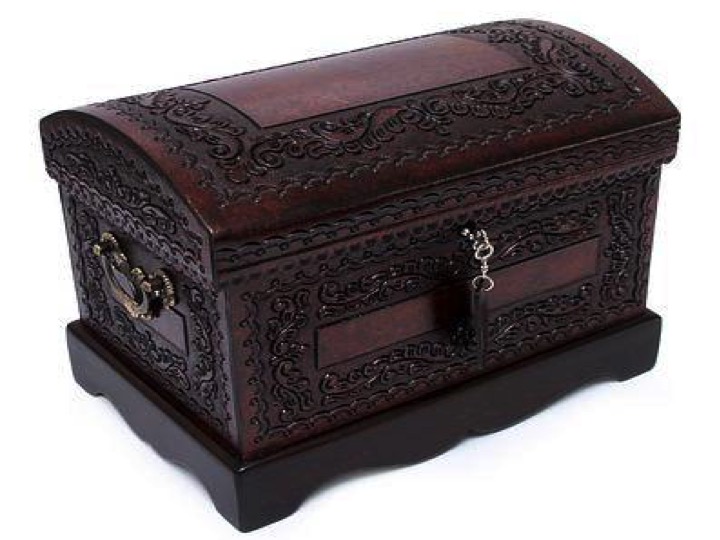
Slide1The villagers destroyed the altar and took the box, not daring to open it. For it was said the long-dead wizard lived only in his illusion, bound to the dry, taut-skinned skeleton folded within the box.

They appointed a watchman to keep the box. Years passed. The wizard was lost in legend and the box misplaced.


Many years later, a poor woman and her son came to live in a run-down cottage at the foot of the mountain. The boy’s father, a woodcutter, had died years earlier and left them penniless. The woman worked, sewing and mending clothes for the village and caring for her son. The boy tended their small garden and patched the roof of their cottage. Times were hard, food ran short, and the woman grew too sick to keep up with her mending.

The boy was clever and ambitious but feared to leave his sick mother alone. One day, he went to the garden and found only two radishes and a turnip. Not wanting to see his mother cry, he went in search of food.


A stream flowed from the mountain and ran past their village down into a dark wood. Villagers took water from the stream but never fished or lingered, for it was said to have an ancient curse. Those who tarried along its banks heard voices in the splashing water, and several said they’d seen a handsome Prince bathing.

But the stream was also known to have many fish, and boy and his mother had not eaten a full meal for many days. The boy took a pole, and worms and grubs he’d dug from the garden, and went to the stream. No sooner had he sat on the bank than he heard a call.

“Greetings.” The pleasant male voice flowed from an eddy swirling behind a smooth stone. “You look tired, my son. Perhaps a drink might refresh you, and a bath cool your feet.”

“Thank you, Sir,” said the boy, looking warily for anyone lurking along the bank. “But I must hurry along after I’ve taken a few fish, if that is permitted.” While they spoke, the boy pulled up one good-sized trout after another.

“You are welcome, my son. I am generous and have many fish to share.” A splash curled back into the flow. “But if you must go so soon, let me give you something to go with your fish.”

The grass beside the boy grew tall and weaved a basket. Round stones became loaves of warm brown bread, red apples and tomatoes, and pebbles turned into scallions.

The boy put the four fish he’d caught along with the bread and vegetables into the basket and quickly headed home. As he walked away, the stream crashed its banks. “Come tomorrow,” it said. “You’ll see I have much more for you.”

By the time the boy reached home, the sun had gone down and the cottage was dark. He put the fish in a bucket of water, set the basket of food on the table, and fetched wood for the stove. His mother had gone to bed early, so he decided to wait to surprise her with a meal.

The following morning the boy found his four fish ready to clean and cook, but the basket had become a mat of dead grass piled with stones. The boy prepared the fish for breakfast and decided not to tell his mother about his strange encounter. That afternoon he went back.

The stream called warmly as he approached, “How did you and your mother enjoy the food?” The boy cast his fishing rod and instantly felt a fish on his line. When he removed it, he felt another then another, as fast as he could cast.

“Those were fine gifts,” the boy answered, “and my mother thanks you.”

As they spoke, a young girl walked to the stream with two jugs slung on a pole across her shoulders. The boy watched as she filled the jugs but did not speak. She was the mayor’s beautiful daughter, a delight to his eyes in her bright blue dress tied with a braided, red cord. As she filled each jug at the stream, she held back the red cord to keep it from getting wet. On rising, she flashed the boy a smile that outshone sunshine.

“She can be yours, my son,” gurgled the stream. “You deserve her. I can make her come to you and anything else you want. See the glitter in my banks?”

A gold coin shone in the silt and beside it another. Scooping his hand, the boy came up with several coins, gold and silver, bearing images from a kingdom long ago. Forgetting his fear, he followed the coin path down toward the water and filled his pockets.

The boy heard a splash further out and, looking up, saw the mayor’s daughter wadding in the stream. She held her polka dot dress high, keeping it from the rushing water and revealing her long-tapered legs. The boy noticed the water flowing past her legs had no wake or eddy, and her steps made no splash.

He stumbled back onto the bank, collected his fish, and ran for home.

“Come again tomorrow,” called the stream with a gurgled laugh. “I have much more to give you.”

When he got home, he showed the coins to his mother. She turned them over in her hands. Then she told him the legend of the treasure that had never been found, and how a wizard used illusions and false promises to lure his young victims. She forbade him ever to go back.

Next morning, he slipped out early before dawn. He found the stream surging violently when he arrived. “Are you angry, Sir?” he asked. “Perhaps I should not have come.”

“Not at all, my dear boy,” said the stream, its waters becoming suddenly still.

“With your approval then, I’ve come to fish once more.”

“Please do take some of my fish. I am feeling much better now that you have come. I want to give you riches and favors beyond anything you can imagine. Want more gold … see here on my bank.” The boy again filled his pockets, but this time was careful not to enter the water.

“Your gifts are very fine, Sir,” the boy said, willing calm into his voice. “But what more could I wish from your generosity?”

The stream quickened but remained unruffled. “To the one I choose I can give wealth and power, glory and fame. You will live in a palace. All men will envy you, and every girl you see will wish to be in your company. But I cannot do these things here in this place in this form. I must first be restored to my real self.”

The boy cocked his head, eyes wide. “Alas, I am a only a simple country boy with no great powers.”

“Do not worry,” my son. “If you release me, I will give you everything and all power. You can remake the world as you wish. But first you must release me.” As it spoke, a wave swept across the bank revealing the corner of a small black box carved with symbols. The box was covered with silt and water-stained, but when boy lifted it from the bank, it glowed as if newly lacquered and polished.

“Take the box home and open it,” the stream said sternly. “Then I will keep my promise, and you will live happily forever after.”

The boy nodded, tucked the box under his arm, and headed home.

As he neared the cottage, he heard his mother singing and smelled stew boiling on the stove.

Inside he found the mayor’s beautiful daughter standing on a small stool, her arm raised while his mother fit her in a new dress. The girl smiled and lowered her eyes. His heart melted. He touched her arm to see if she was real. She returned his touch and handed him the braided, red cord she’d kept from her old dress.

“Keep still,” said his mother through teeth clamped tightly on straight pins.

The boy looked at the black box in his hands then at the boiling stew pot on the roaring wood stove.

Two frail, boney hands reached out, grabbing at his wrists. The boy quickly slid the box into the mouth of the stove. As he pushed the box back with a poker, the boy saw an ancient face scream silently, and watched tongues of fire hungrily claim it.

He turned back to the room, fearful of what might be missing. His mother, the mayor’s beautiful daughter, the gold, and the fish he had caught remained in sight.

With the strange voices and images no more, the villagers soon returned to fish the stream and picnic along its shore. The boy’s mother recovered her health. He and the mayor’s daughter married and lived happily. Perhaps they still do.