Discover The Starflower: Now in Audiobook on Audible, iTunes, and Amazon

Austin Macauley Publishers informs me that The Starflower is now available in audio format on Audible, iTunes, and Amazon.

The reader learns of this far future universe and all its colorful details through the eyes of Gayle Zimmon, a young woman who grows up on a remote planet barely more aware of aliens, AI, and genetically engineered humans than she is of walking in heels. The story unfolds for the reader as it does for ‘Zim’. This week The Starflower received another 5-Star Amazon review:

Worldbuilding at its Finest

January 28, 2025. The Starflower is an exciting adventure with the philosophical undertones that great science fiction is known for. Zim is a spectacular female hero. She is tough and insightful. It is a spy novel, political thriller, and futuristic fantasy, all tinged with a bit of magic (the prophecy). I hope there is a sequel. I would follow Zim anywhere!

Those We Left Behind

Readers don’t know what was cut, but writers know and may miss those they left on the cutting-room floor. And characters and scenes discarded to speed one story may have stories of their own to tell. These can return in sequels and side stories or spin off and fade like stories in our own lives. In my novel The Starflower some of my favorite untold stories are those of the alien warrior Tock.

Elder Hall – A Starflower Story

The flat, unadorned dome of Elder Hall was one of the few major structures on Tak-Yakon’s surface. 

Chirik, Ticket-Tockoket-Click. The lead elder ratcheted the traditional Chirik greeting and Tock’s full name, snapping the final click with its great claw. The other elders, one to each side of Ki-Ku-Li, tipped their triangular heads and waited as Tock centered its stick legs between the gaps of the clover-lobbed seat. These three led the Tak-Yaki military-caste. Tock was their field commander. 

The one-and-a-half-meter mantids each had two serrate-jawed clamp-claws, four stick-thin walking limbs, and dark-blue carapaces that softening to violet on their undersides. Garnet-faceted eyes topped the upper corners of their triangular heads with two alert antennae between them. The mandible-mouths in the low corner of their heads stirred with finger-like pedipalps.

Chirik, Elder Ki-Ku-Li, click-tirock.” Tock returned the greeting and tip-nodded its head to the other elders.

“Forgive our informality, Marshal Tock,” Ki-Ku-Li continued. “Before you left to assess our new Human allies, you mentioned their reputed ferocity possibly complementing our own.”

Antennae leaned forward as Tock began. “Due to their hostile natures, Humans barely survived long enough to master star travel and have made their world practically uninhabitable. After two mismanaged attempts, they successfully terraformed Corydon and relocated the Human population. Their two early attempts on Thrinlu and Scalaris continue to struggle and have progressed slowly.”

Seeing Ki-Ku-Li’s pedipalps fret, Tock jumped ahead. “To speed Human survival and recovery from war damage, the leaders of Corydon’s Star Council initiated a eugenics program, including selective breeding and genetic manipulation. Those selected they called Creatives. Those discarded, the Unders, they consigned to the less favored worlds Scalaris and Thrinlu.”

The antennae of the elder to Tock’s right pulled in. “Not unprecedented for a struggling species. I recall how our Tak-Yaki program reset our social order.”

“And it has with Humans, too.” Tock continued. “As a guide for genetic selection, Humans run annual competitions, combat trials they call the Corydon games or Corydonics, recalling games from ancient Human history. The first-place winner was to receive the Corydon Star and priority selection in the gene pool.

“Due to the combative nature of the Humans’ games I was keen to observe them, and the Star Council invited me to join them in their judging booth.”

Ki-Ku-Li stroked the underside of its mandible mouth with a massive claw. “Before going into detail, did you find any surprises?” 

“Although Humans are more elusive and contrived than we Tak-Yaki, aspects of their games reminded me of our Daka-Rye drills. That could play well in our alliance, but that was not my major surprise.”

Antennae angled forward and garnet eyes gleamed atop the three elders’ heads.

“Star Council’s plan was to populate Corydon with the improved Humans then expand to other terraformed worlds. None expected discarded Unders to challenge engineered Creatives, so Star Council extended invitations to all Humans, including those on Thrinlu and Scalaris.”

Tock extended a claw absently to stroke a bent antenna. “When two Unders accepted the invitation for Scalaris, they drew immediate attention. Expecting the upstarts to die or be eliminated in the first round, Star Council took no action. But the couple won not only the first round but the entire competition with Gayle Zimmon receiving the high individual score.

“As the Corydon Star was intended to recognize the top Creative, Star Council refused to award it to an Under. Instead, they gave her a one-time medal styled on a weed native to Scalaris, a Starflower. They intended the medal as an insult, but Zimmon accepted her award gracefully.”

Ki-Ku-Li rolled its wide, flat claws out. “This Human shows character, but why have you brought her story to Elder Hall?”

“The Aldrakin War broke out shortly after the games, and we and the Humans became allies. As winner of that year’s combat games, Gayle Zimmon was called up and entered basic as a top officer candidate. Other top candidates included many she had just defeated in the Corydonics. It didn’t go well. When they attacked her, she put one in the infirmary. As a visiting ally, I witnessed the assault. Zimmon showed controlled restraint and could have killed her attacker. But that wasn’t how the military commander saw it. At the reception that evening, Zimmon’s training squadron assigned her the call sign Starflower, continuing their insult.”

“And you brought this to Elder Hall, why?” Ki-Ku-Li asked again.

“When Star Council’s Chief Military Officer Abramyan was uncertain how to proceed, I recommended that our alliance would benefit from a liaison officer, someone to learn Tak-Yaki war methods and orchestrate blended actions. If details could be worked out, Gayle Zimmon might complete her basic training with us on Tak-Yakon. Abramyan leaped at the opportunity to clear his claws of his troublemaker. Human media has been obsessed with ‘the Starflower’ ever since the combat games, and he wants to rid himself of the distraction.”

The elders’ heads rocked up as Tock concluded. “I’m impressed with this Human and see great possibilities in this exchange. However, we have never included an alien species in our military training. I need your go-ahead to proceed.”

Xanadu Books Interview

I enjoy interviews (hint to any readers in that business) and had fun working with Xanadu Book Awards & Press. Their approach concentrates on a writer’s motivation and personal resources. To my experience, writers can be very different. Especially creative writers who think outside the formula.

More Truth Said in Fiction

I am often asked how a technical analyst (42 years in intelligence) came to write speculative fiction, and sci-fi in particular. I touch on this in the blog description: “More truth is said in fiction.” And watching a Jack Reacher movie a few months ago, I heard a similar comment from a defector: “Fiction has to make sense, intelligence does not.”

Many authors have chosen to couch serious societal comments in fantasy and fiction worlds. Mary Shelley’s Frankenstein expressed concern that scientists caught up in research would fail to consider its consequences. Kurt Vonnegut’s Cat’s Cradle expressed similar concern, and Player Piano projected an automated world that crowded out human labor. In Gulliver’s Travels, Jonathan Swift casts his societal satire in fantasy/SF worlds of miniature humans, giants, intelligent horses, and detached intellectuals floating about in a city in the sky. Consider Orwell’s Nineteen Eighty-Four and Animal Farm, both of which had trouble finding publishers because, as he was told, Joseph Stalin might be offended.

These and similar stories might be read for light escapism. The authors understood that in their time many were not ready to grasp their stories’ deeper implications. I suggest that their choice of fantasy and SF settings has much to do with these stories still being read today.   

A Five Star Review of The Starflower, 13 September, 2024.

This was a vibrant story about the universe in the distant future…I believe a year that was mentioned was 3569 but that was at least a few years before this story takes place. A young military woman, The Starflower, became a hero to humans and many other alien species alike after numerous successful battles against the Aldrakin species that was waging war on many planets unable to fend for themselves. After a surprise attack that she strategically won subsequently ending the war, she is faced with jealousy from the Star Command back home. She may have ended the war, but the true enemy was still at large and had it’s targets set on her and her lover. 

I was a little confused at the start of the book because it drops you straight into an immersive new world. I was able to easily find my way out of that confusion within the first few chapters and really got drawn into the story. The author was really able to make you imagine how these new worlds and alien species look and act. I found it absolutely fascinating. This is the best sci-fi book I’ve read in a while. Also as an editor I found very few errors so it was a nice clean read I could enjoy.

What’s next you ask?… We get rid of her.

The war has ended, but not the way Star Commanded wanted. They are not happy. An excerpt from The Starflower.

Malik flipped through the headlines without speaking. Her office was perfect for interrogation: austere, snow-white, windowless walls, angular, black-upholstered furniture. Glare from the overhead burned Abramyan’s eyes. Despite his formal uniform and sweat-beaded face, he felt naked and cold. He knew what Malik would ask, and he had no answer.

“How did you let this happen?” she shouted, throwing up her arms. “You told me Zimmon would never be put in any combat zone. Sidelined, you said.”

Her gnarled, brown-mottled finger poked from her black sleeve at the projection. WAR ENDS – STARFLOWER VICTORIOUS! She flicked to the next headline: STARFLOWER ENDS WAR! Then the next: STARFLOWER BLOOMS! “Who authorized Zimmon to end the war?” Malik’s robe flared like an angry cobra hood. 

“And this, AAAArrr.” She raked skeletal palms down her face then pulled up the next projection. The classified transmission indicated that, without authorization, military units had gone on alert and prepared to head to Bai-Yota in support of Five Squadron. “Our battle fleet supported her,” Malik screamed. “We were very, very lucky this didn’t go further.”

Abramyan had read the traffic. Each condemnation came like a twisting spear thrust. Jen Djada, the only other Councilor in the room, sat quietly by the door.

Malik spoke to Abramyan’s stone silence. “What’s next you ask?”

Abramyan couldn’t help blurting, “Lord Malik, Bai-Yota was a surprise. I didn’t, Zimmon didn’t, HELL, the Aldrakin didn’t know. They thought they’d catch us—”

Excuses? Now you make excuses?” Malik gripped the edge of her desk with shaking, predator talons. “I’ll tell you what’s next. We get rid of her. That’s all, just get rid of her. We do it clean, we do it quiet, but we get rid of her. Soon as she reaches Corydon, you know those Under-lovers will be all over her…and Creatives, a lot of Creatives see her as some sort of righteous underdog.”

Abramyan trembled like a child caught in a snowstorm. Behind him, Djada’s jaws flexed.

Malik blew a long breath. “We can’t afford an uprising. Not now, not this close. Some of us are already in transition.” She examined her cadaverous hand then pointed toward Djada. “You still have contacts with the Rii-Chaut? They hate us but love our money.”

“I’ll tell the Yazza Hetman we have more business for him.” Djada’s self-assured demeanor unnerved Abramyan. “Ojai Khan staged the incidents that started the war. He can be discreet. When do you want it to happen?”

“Ojai Khan, yes, that went well.” Malik clapped her hands silently then pointed. “And when you see Khan, tell him I’m angry about the Silkani raid. That base was off limits. We say where to and where not to attack.” Djada gave a leaning bow from her chair.“As to the when question. Don’t have Khan kill Zimmon too soon. That would raise suspicion. We don’t want to make this little Starflower girl into a martyr.” She tapped a finger on the desk. “Let’s be positive. Unders love the Starflower. We love the Starflower, too.

Five Star Reviews

Not all the reviews have been five-star, which is understandable in an epic story that lays out an entirely new universe. And some readers prefer cozy, warm stories. Zim preferred that sort of life, too. She didn’t get it.

Thrilling SciFi Fantasy with incredible worlds to discover Reviewed in the United States on September 7, 2024

The overarching themes of this book are somewhat reminiscent of Gattaca (in its take on Eugenics and how it might affect human hierarchy) and also of Dune (in its prophetic ideas of a single person to unite and fight for the less fortunate). Nevertheless, this story takes a unique approach to both of these themes. The main character “Zim” (callsign “StarFlower”) is both endearing and realistic. She is thrust into a prophecy when she least expects it, and all that ensues is both exciting and terrifying. The characters are very enjoyable in their depth, and I enjoyed the vast universe that the author creates. I like the combination of good story telling with so much to unpack that it will surely be a great series!

Kirkus Reviews

I was very pleased with the review Kirkus Reviews gave to The Starflower:

A fast-paced SF novel featuring a vast world rich in intricate cultural details.

In Kenny’s SF novel, a woman finds herself at the center of a universe-spanning prophecy.

Gayle Zimmon, going by the military call sign “Starflower,” is an “Under,” a class of human that is considered lesser and relegated to working in the military forces and service jobs, living under strict rules regarding relationships and procreating. Despite this lowly designation, Zimmon has made a name for herself for her skill and prowess in the campaigns she has served in during the war against the alien Aldrakin. But Zimmon’s growing popularity with the oppressed Unders has made her the bane of the Star Lord Malik and the Star Council, who force her to serve in the desolate world of Bai-Yota, stuck in the middle of nowhere. Despite how quiet this assignment was expected to be, Zimmon finds herself in the middle of a decisive battle ending with the Aldrakins’ surrender. It’s when meeting with the Aldrakins to finalize the terms that she hears about their prophecy (“The Starflower blooms in the enemy camp, and you shall know her, for she shall be the warrior you cannot defeat”) for the first time; the weight of a whole universe seems to fall on her shoulders, even if she doesn’t fully believe it. Though the war may be over, Zimmon’s trials are just beginning: The Star Council refuses to allow the possibility of her serving as a figurehead for an underground uprising, so she must dodge assassination attempts, play diplomat to a variety of species, and potentially start a new life with her lover, all while somehow fulfilling the mysterious prophecy. In this SF yarn, the author weaves a wide web of fascinating alien cultures. Zimmon is a fascinating character, though she seems almost too perfect at times; perhaps it’s hard to not be spectacular when you’re the object of an alien race’s belief system. Kenny really shines in his depiction of the cultural aspects of the different alien groups—each is distinct, clearly thought-out, and entertaining to read about.A fast-paced SF novel featuring a vast world rich in intricate cultural details.

https://www.kirkusreviews.com/book-reviews/k-kenny/the-starflower-3/

When Aliens Tried to Help

“What ya doin’ now?” Justin asked.

“Same as eight minutes ago … making friends.” Greg’s eyes darted as his fingers skipped over his lap device.

Justin peered over Greg’s arm. “How many friends you got now?”

“A lot … five … six … seven … since morning I’ve added two thousand, two hundred and seven … eight … nine …” Greg clicked down the accept list.

Justin threw his arms out and flopped back in his chair. “Wow! You’re the most popular guy I know.”

“Don’t say guy, someone might take it the wrong way.”

“Sorry. You ever gonna meet any of your new friends?” Justin asked. Greg shook his head. “Not even the girls? Girls really go for popular guys, I hear. Makes ‘em get all … you know … like … ahh, excited.”

Greg faked a yawn. “Since when? Girls get all their fantasy characters online, avatars wayyy cooler than me. That way they get to play like they’re magical princesses and don’t even have to comb their hair.”

“I thought it was just me they didn’t like,” Justin said and grimaced.

“Been that way ever since the world got perfect. Who wants normal dudes? Too much work.” Greg shrugged, and Justine went back to clicking.


The galactic overseers watched the scene as they rocked in silence in the mist of the saline hearth. When the monitor darkened, Otch turned to Cot. “You see what we’re up against? That was years ago. We didn’t do anything then, and it’s gotten much worse.”

Cot did not respond and continued waving its many eyestalks in the warm, briny mist. Then it casually lifted a slark worm from the hors d’hoeuvre tray and proceeded to sip extrusion from its shell.

Otch pressed. “Tell me, Cot, how are your humans doing?”

Cot paused only an instant then returned to slark-surping.

Too direct, Otch thought. Cot was sensitive about discussing its humans. Every conversation they’d had on the topic had ended with an argument. Otch retracted its eyestalks, biding its time while Cot ate.

When the last of the slark disappeared from the tray, Otch tried again. “I’m sorry Cot, but I must persist. As you saw on the monitor, my humans are failing to thrive. I don’t know what’s wrong with them. I’ve done everything to make them happy, given them everything they’ve asked for, and yet they’re dying. Humans don’t know they’re no longer on Earth, but the problems began right after the relocation …” No response. Otch knew what Cot wanted.

“Okay, I apologize,” Ocht said. “I admit, you may have been right about the humans. And I was wrong to side against you in the relocation meeting.”

“You laughed at me,” Cot finally said, its tendrils oscillating.

“I’m sorry for that, too.”

“Then you voted to have my opinions struck from the record.”

“And that, too. But listen, Cot. Nothing is working. The new habitats are identical to the ones humans had on Earth. We just removed the obstacles and smoothed the rough edges—diseases, poor climate, shortages. We made everything perfect for them. Abundant delectable foods, lavish entertainments, rewards for every act, complete safety. We know we missed something. I’m down to a few dozen females, no males. Justin and Greg are gone. When females showed no interest in them, the males kicked around for a while then just stopped living.” Cot nodded as if this should have been expected.

“We want you back on the team,” Otch said. Cot nodded and, after a beat, Ocht asked again, “So how are your humans doing?”

“I’ve got twelve hundred and thirteen,” Cot said quietly.

“No, that’s not possible,” Ocht said, his voice rising in disbelief. “That would mean an increase. Are you saying your population has grown?” Cot nodded. “What? You’ve found some new entertainment for them … some new drug?”

“We’ve had this discussion before, and I won’t go through it again. You and the relocation team only want to hear answers that support your thinking.” When Ocht began to protest, Cot held up a dozen tendrils. “I think we’re done here. Thank you, old friend, for the most excellent slark worms.” With that, Cot bowed and slid from the room.

david-clode-a0F4kX9nLBU-unsplash

On returning to its neighborhood, Cot donned the guise of a barn owl and flew out to visit its humans. They worked together to grow food, traded goods, repaired homes and various devices, talked about last night’s storm and how their children were doing in school. Boys and girls talked, sharing their dreams and plans. And everyone complained about how hard life was.

Invaders from Space, Part 2

In last week’s blog post: At the clan council fire, bird-like warriors discussed how to deal with the invaders from space. Leal suggested that they might be trying to communicate.


It had been five hundred years since Galactic Phoenix left Earth for a distant star system. Peter Odanoff hadn’t uploaded until just before the landing, but standing on the deck of the lander and viewing the deep orange sunrise made him nostalgic for home.

Wispy clouds on the western horizon indicated a summer storm building. The undulating string of winged creatures flying just ahead of the storm could have been a flock of migrating geese. He imagined his actual eyes squinting and the warmth of sunshine on his face. He swept an open-fingered hand over his head then jerked it back. He’d forgotten. No hair. Only contoured metal and the memory of hair.

After surveying the landing site, they’d spent the first day cutting and splitting cane stalks to build the deck. Its ramp was the only way to access the lander other than the telescoping ladder, which was difficult for Julia’s and Jeninne’s engineering chassis and for their dog Chloe.

Julia Rabkin the physical scientist had selected the landing site, a bare, level spot beside a gorge with access to potable water. The mountain-ridged horizon meant possible mineral resources. Jeninne Sobek the life scientist had started a research and vegetable garden. Our robot chassis required no organic food or medicine, but if things went well, soon there would be children, real children.

Peter was the pilot and chief technician. Though he missed Earth, he had no regrets. Interstellar travel had fascinated him from his youth. He knew his real self had lived a normal human life and been dead for centuries. How many children and grandchildren did he have now? Maybe they’d sent pictures along with software updates. He’d check when the day’s work was done.

The Russian engineers had done an amazing job, but Russians are known for their no-frills practicality. They put optical and aural sensors in his head, and thermal, tactile, and chemical sensors in his hands—so Peter’s hands could smell. He held one up to the morning light. To keep him sane, they’d reproduced his old physiognomy wherever possible. He flattered himself that he was strikingly handsome and was pleased the humanoid chassis reflected that image with a few cosmetic touchups.

Suddenly self-conscious, he pulled his hand down. The last thing he wanted to do was stir resentment. Until they manufactured other humanoid chassis, Julia and Jeninne were stuck with the engineering frames the Russians had given them—more practicality.

“Amazing sight.” Jeninne’s voice came from the agro-planter below the deck.
eclipsing-binaries-e1467453985567

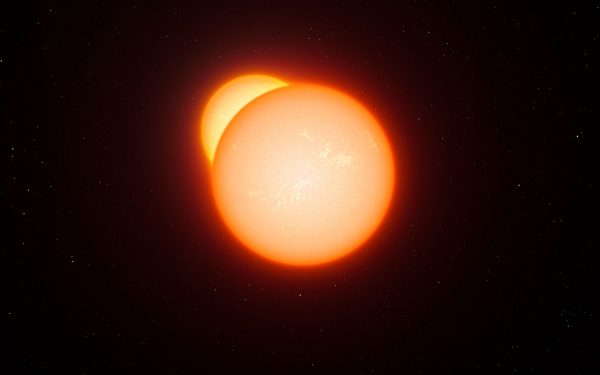
“Yes,” Peter said and pointed. “If not for that second light, the illusion would be perfect.” Beside the sun was its yellow dwarf companion star.

Peter leaned over the rail as Jeninne’s gimbaled sensor whirled to look up. “Did Julia leave? I asked her to wait.”

“She took the geo-rover up the ridge.” Jeninne extended a pruning hook to the horizon. “She said that area tested radioactive. We don’t have feed materials, and the fabricator needs heavy metals.”

“I’d planned for us to scout that area together, but I know she’s been anxious. Any predators about?”

“There’s a man-sized moa-velociraptor-thing stalking the compound. I’ve only seen one, but there could be others. So far it’s kept to the forest. I’m more concerned about that pack of six-legged predators. Two dozen were sniffing the perimeter last night and pooping. They stayed out of the light. Each must weigh about fifty kilos. Julia calls them devil-dogs. They’ve got some vicious fangs and claws. If they go after her on the ridge, she has the laser stun gun, but it only gets three shots to a charge. Until we know what they’re after, I don’t want Chloe running loose.”

Hearing her name, Chloe barked. She was the only live member of the crew. The Yellow Labrador Retriever would soon be the mother of their first children. The nano-implants had already corrected Chloe’s cryo-damage and reset her gestation time.

Jeninne’s lenses swiveled back to Peter on the deck. “Need help with Chloe?”

“No, but would you unhook her tether?”

Peter called, “Chloe, come.” The big, yellow dog bounded up the ramp and, without slowing, made a hard left into the lander’s open bay.

“I don’t imagine Julia’s rover will attract any devil-dogs,” Peter said, “not for food anyway, but they might defend their territory.”

“I’ll try not to worry,” Jeninne said, rotating on her ball-base and rolling to the garden. “I’m testing the seeds we brought from Earth along with some local tubers and seed cases, also a few fern fruits and fungi for possible medicinal applications.”

The base station lab resembled a twenty-first-century, camper trailer kitchen. Peter lifted Chloe onto the white, MechMed counter. He stroked her ears, checked her pulse and breathing, then inserted the anesthesia needle.

He took a rack with four embryo tubes from the incubator, placed one tube in the MechMed, and hit scan. The timer bar glowed soft blue, ninety seconds, eighty-nine, eighty-eight.

Peter pressed the queuing button beside the comm switches above the examination counter. His preferences flashed by—Bach, Beethoven, Dvorak, Sibelius—as they had every morning for the past seven days. He liked starting the workday with the final movements of Beethoven’s Ninth Symphony, “The Choral” in D Minor, Op. 125.

A bell chimed once and the panel beside the timer bar flashed CLEAR in soft blue. Peter removed and examined the tube, restored it to the rack, and placed a second tube in the scanner. He hummed then whistled along with the music. This time, after ninety seconds, the bell chimed three times rapidly. The panel flashed ERROR 0.07% alternating with CORRECT? Peter touched the panel. A fraction of a second later a single bell chimed and CLEAR displayed. Quantum deterioration could be expected after so long a time, even near absolute zero. He removed the second tube, switched it, and placed a third into the MechMed.

When the “Ode to Joy” began, Peter sang along, Freude, schöner Götterfunken. He had sung in the chorus at Swarthmore and felt a familiar thrill rising. Suddenly, from the open hatchway behind him, he heard the sound of a melodious flute accompanying him.

“Wonderful, Jeninne, how are you doing that?” A bell chimed and CLEAR displayed. As he removed the third tube, Peter continued singing.

The flute accompanied the melody flawlessly.

“Magnificent,” Peter said, turning to the hatchway. “How do—”

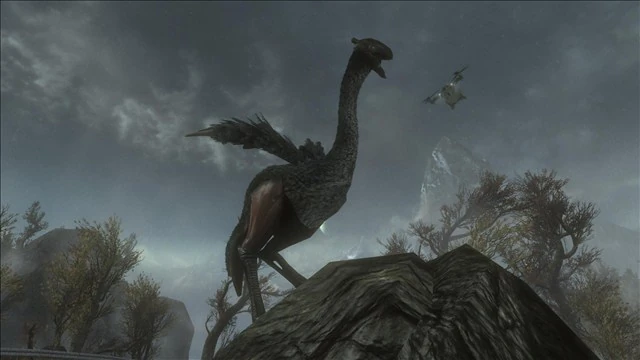
A six-foot, bird-like creature blocked his exit. The creature rocked on its powerful haunches, its black tongue vibrating in its hooked beak like a silver flute. At the end of the musical phrase, the creature lowered and widened its horn-ridged, purple eyes, and centered its beak on Peter’s chest.

He stumbled back against the counter almost dropping the embryo tube. Without thinking, words tumbled from his mouth.

“That … that … that was pretty good … you just do the classics?”

The creature folded its scale-like feathers and opened its beak. “All I hear,” it said in a chime-like voice. “Come for know.”

Peter pulled erect. “You speak English?”

Leal dipped his beak. “Music better.”
Invaders from Space, Part 1

“Ski’i,” Leal cawed to the clan council as he entered the cane forest clearing. Curls of sparks and flame twisted high into the clear night sky above the council fire. Seven warriors returned, “Ski’i,” and dipped their beaks. Firelight flickered off their ridged brows and beaks and set shadows dancing against the forest gloom.

The clan elder swept a wing to the spot beside him. Leal fluttered and folded his wings then rocked down upon the bare ground. It was the place of honor he had earned for driving the Jab-Ron clan from their land.

Leal leaned toward the fire to relieve the night chill. The scent of burning cane and spicy Chen Doe root stirred his nostrils. The incense bound all warriors to speak only the truth in council.

No females came to the fire this night for it was brooding season, and many warriors bore the scars and torn feathers from having been driven from their nests. One of the clan elder’s wings hung limp. The warrior beyond him reflected shining bald spots in the firelight. Leal displayed the short feathers and stubble on his right wing proudly, for his mate was strong and fierce. Ree had also given him a deep gash with her beak that left a blood crescent dried on his breast.

slide1

“Ski’i,” called another joining the circle.

“Ski’i,” returned Leal and the others, dipping their beaks. The newcomer Tarii extended his neck and pulled upright before sitting. A young buck porod squirmed in his beak, kicking and scratching with its six, sharp-clawed legs. Tarii tossed and caught the porod by its neck then gave a quick shake. He set the fresh kill before the clan elder then backed to the opposite side of the circle.

Impressive show, Leal thought. Porod are savage fighters, and this was a strong, young buck. Too bad the fledged females weren’t here to see the display: Tarii might have had his pick.

Unlike the mated warriors, Tarii’s feathers were full, combed, and unbloodied. Leal knew that next season they would not be. Last year Tarii had challenged him for the right to mate with Ree. It had been no contest, and there was no bad blood between them. Adolescent warriors were expected to strut and challenge, and Ree was as beautiful and intelligent as she was formidable.

“Brooding season goes well?” The elder counted only bobbing beaks. “Game plentiful … water flows … mates and young ones?” More bobs. “Good, then to our main concern. There has been another incursion in our realm.”

Tarii and two others pointed and bobbed three times, indicating three valleys to the southwest.

“Your sector again, Leal. Have the Jab-Ron returned?”

“Not Jab-Ron, of that I am certain. I saw their disk fall from the stars and settle on the cascade overlook as gentle as a twirling Chen Doe blossom. I also watched them set up camp.” All beaks turned toward Leal.

“How many?” the elder asked.

“Four, and they are all quite different from one another—each specialized for a different task. Some have interchangeable claws, limbs, and mouthparts. But none resembles the Jab-Ron or any of our species.” Leal said. A cane log cracked and collapsed, sending a spray of sparks arcing up from the fire. The scream of a lallow pierced the night air then ended abruptly, no doubt a night-stalking aglak had caught its dinner.

“One of the intruders stands on two legs as we do and is nearly our size. It has neither wings nor beak, and its body is made of metal. Two other creatures are also made of metal but have boxy bodies. One has six articulated legs like the web-spinning hindergoss, and spends its time roaming our hills. The other has rolling feet and claws that dig in the dirt. The only intruder of flesh is less than half our size. It has four legs and is covered with downy, tan fur like an adult porod. This one spotted me and alerted the others. It bared its fangs but did not pursue when I backed away.

“Weapons?” asked the elder.

“Only one. The roaming, hindergoss creature carries a weapon that shoots burning light. Other than that, they and their camp appear defenseless.”

“Have any porod packs attacked them?” asked the elder.

“No, but they’ve marked the camp with dung piles and scented a path for a night attack. Tracks indicate that several packs are working together. I believe they’ve held back for fear of the intruder’s sound shield.”

Sound shield?” The elder rocked and stretched its long neck and head toward Leal. “A defensive weapon? Have you seen it in operation?”

“If it is a weapon, it causes no harm to us,” Leal said. “I find myself curiously drawn to it, and that may be its true purpose—an attempt to communicate. The sound shield has structure, and I’m certain it carries coded information. I am able to replicate some of the sounds and believe I may soon be able to understand them.”

“Very interesting. Continue your investigation, Leal, and report back at the next council.”

Conclusion next week.