The Starflower

This has been a great year for “Strange Things Done”.

Several of my short stories have been published, four this year, my best year. And Austin Macauley Publishers informs me that advanced copies of my SF novel THE STARFLOWER are available in soft back now on their site: https://www.austinmacauley.com/us/book/starflower

The official publishing date is 18 August 2023. The Epub and audio should be available at other sites shortly.

The Starflower

“Once People Danced”

My fourth short story for ’23 “Once People Danced” was published in ACROSS THE MARGIN on 27 July: “A work of science fiction wherein enlightened life forms from a civilized future consider the dark days of a twenty-first-century teeming with primitive humans…” This has been a great year. My SF novel THE STARFLOWER is set to publish on 18 Aug.

“What I Played for Love”

Another of my short stories was published at the end of June. That makes three this year—a personal record. In “What I Played for Love” an older man smitten by a younger woman fails to read his contract and gets taken. Dark Horses: the Magazine of Weird Fiction No. 18 is only in hard copy and is available on Amazon:

Amazon.com: Dark Horses: The Magazine of Weird Fiction No. 18: July 2023 (Dark Horses Magazine) eBook : Spitzer, Wayne Kyle, Watson, Stuart , Lang, Noah , Bondies, Michael , McGlyn, Jessica , Franks, Lillie E. , Sumner, Tiffany, Gielo, Bob , Harper, James , Kenny, K.A. : Kindle Store

Second Chance – A Bewildering Story

Bewildering Stories welcomed me as one of their authors and gave me my first publication for 2023. “Second Chance” began as a character study with no redeeming characters. Kip told me what happened in an interview.

Kip a criminal serving time collecting trash in space is given an opportunity to mend his ways…or not. See the story by K.A. Kenny.
http://www.bewilderingstories.com/issue987/

Never Leave Me

My third story to be published this year appears in Altered Reality.

A scientist learns the limits of science. It seems neither love nor science conquers all.

Better Pets

“I’m six years old today, Daddy.”

“Happy birthday, Button. After lunch we’re having a birthday party for you. All your friends are coming, and they might even bring you some presents.” Dave smiled, nodding wide-eyed.

“I remember once you told me when I was six years old I could have a puppy?” Dorothy said, rocking as she stood.

“I remember saying that if Mommy agreed you might have a puppy.” Dave chose his next words carefully. “You know there aren’t any real puppies or kitties anymore. All gone. Now we have robots. Easier to care for and better for the environment.”

“I know that.” Little Dorothy’s body wobbled as her head bobbed. “My teacher told me that at school. She said old robots need homes. When they wear out, people put them into new furry bodies and teach them to play with children, wag their tails, and lick my face, and love me, and sleep in my bed, and keep me company when I’m sad, and—”

“Yes, I think the new doggies can do all those things, even purr if you want them to. People program them for all the things you want them to do.”

Dorothy scrunched her mouth to one side and dropped her eyes. “Mommy didn’t want me to have a puppy. But I told her you promised, and she said it was okay.”

Dave put on his best frown to look upset. “Okay, Button. But when you go to the shelter, I’ll go with you. I don’t want you picking out a hair dryer or a vacuum cleaner.”

Dorothy giggled. “That’s silly, Daddy. Why would I get a vacuum or hair dryer?”

Dave lifted his daughter onto his knee. “Of course, you wouldn’t do that on purpose, but you might make a mistake. Robots never die and some are very old. Long ago people made them to do just one thing, like clean floors, or wash dishes, or play games like chess. That made some people angry. They said robots should all be created equal. After that, all robots got the same brain even when they only did one thing.”

laura-dewilde-E8Nz33JqT60-unsplash

When Dorothy rubbed her hands in worry, Dave raised his tone and lifted his arms. “Of course, it might be nice to have a doggie that cleaned instead of messed on the floors.”

Dorothy laughed, gave her father a neck hug, then looked up into his face. “I’m sorry, Daddy. I didn’t know you wanted to go to the shelter. I wanted to have my puppy here with me for my birthday party.”

“That’s okay, Button. I’m sure if Mommy went with you, everything will be wonderful.”

“Oh, it will. My doggie will have black and white fur with floppy ears, and …” She paused. “Daddy, remember when you said I could have a giraffe?”

When Aliens Tried to Help

“What ya doin’ now?” Justin asked.

“Same as eight minutes ago … making friends.” Greg’s eyes darted as his fingers skipped over his lap device.

Justin peered over Greg’s arm. “How many friends you got now?”

“A lot … five … six … seven … since morning I’ve added two thousand, two hundred and seven … eight … nine …” Greg clicked down the accept list.

Justin threw his arms out and flopped back in his chair. “Wow! You’re the most popular guy I know.”

“Don’t say guy, someone might take it the wrong way.”

“Sorry. You ever gonna meet any of your new friends?” Justin asked. Greg shook his head. “Not even the girls? Girls really go for popular guys, I hear. Makes ‘em get all … you know … like … ahh, excited.”

Greg faked a yawn. “Since when? Girls get all their fantasy characters online, avatars wayyy cooler than me. That way they get to play like they’re magical princesses and don’t even have to comb their hair.”

“I thought it was just me they didn’t like,” Justin said and grimaced.

“Been that way ever since the world got perfect. Who wants normal dudes? Too much work.” Greg shrugged, and Justine went back to clicking.


The galactic overseers watched the scene as they rocked in silence in the mist of the saline hearth. When the monitor darkened, Otch turned to Cot. “You see what we’re up against? That was years ago. We didn’t do anything then, and it’s gotten much worse.”

Cot did not respond and continued waving its many eyestalks in the warm, briny mist. Then it casually lifted a slark worm from the hors d’hoeuvre tray and proceeded to sip extrusion from its shell.

Otch pressed. “Tell me, Cot, how are your humans doing?”

Cot paused only an instant then returned to slark-surping.

Too direct, Otch thought. Cot was sensitive about discussing its humans. Every conversation they’d had on the topic had ended with an argument. Otch retracted its eyestalks, biding its time while Cot ate.

When the last of the slark disappeared from the tray, Otch tried again. “I’m sorry Cot, but I must persist. As you saw on the monitor, my humans are failing to thrive. I don’t know what’s wrong with them. I’ve done everything to make them happy, given them everything they’ve asked for, and yet they’re dying. Humans don’t know they’re no longer on Earth, but the problems began right after the relocation …” No response. Otch knew what Cot wanted.

“Okay, I apologize,” Ocht said. “I admit, you may have been right about the humans. And I was wrong to side against you in the relocation meeting.”

“You laughed at me,” Cot finally said, its tendrils oscillating.

“I’m sorry for that, too.”

“Then you voted to have my opinions struck from the record.”

“And that, too. But listen, Cot. Nothing is working. The new habitats are identical to the ones humans had on Earth. We just removed the obstacles and smoothed the rough edges—diseases, poor climate, shortages. We made everything perfect for them. Abundant delectable foods, lavish entertainments, rewards for every act, complete safety. We know we missed something. I’m down to a few dozen females, no males. Justin and Greg are gone. When females showed no interest in them, the males kicked around for a while then just stopped living.” Cot nodded as if this should have been expected.

“We want you back on the team,” Otch said. Cot nodded and, after a beat, Ocht asked again, “So how are your humans doing?”

“I’ve got twelve hundred and thirteen,” Cot said quietly.

“No, that’s not possible,” Ocht said, his voice rising in disbelief. “That would mean an increase. Are you saying your population has grown?” Cot nodded. “What? You’ve found some new entertainment for them … some new drug?”

“We’ve had this discussion before, and I won’t go through it again. You and the relocation team only want to hear answers that support your thinking.” When Ocht began to protest, Cot held up a dozen tendrils. “I think we’re done here. Thank you, old friend, for the most excellent slark worms.” With that, Cot bowed and slid from the room.

david-clode-a0F4kX9nLBU-unsplash

On returning to its neighborhood, Cot donned the guise of a barn owl and flew out to visit its humans. They worked together to grow food, traded goods, repaired homes and various devices, talked about last night’s storm and how their children were doing in school. Boys and girls talked, sharing their dreams and plans. And everyone complained about how hard life was.

Invaders from Space, Part 2

In last week’s blog post: At the clan council fire, bird-like warriors discussed how to deal with the invaders from space. Leal suggested that they might be trying to communicate.


It had been five hundred years since Galactic Phoenix left Earth for a distant star system. Peter Odanoff hadn’t uploaded until just before the landing, but standing on the deck of the lander and viewing the deep orange sunrise made him nostalgic for home.

Wispy clouds on the western horizon indicated a summer storm building. The undulating string of winged creatures flying just ahead of the storm could have been a flock of migrating geese. He imagined his actual eyes squinting and the warmth of sunshine on his face. He swept an open-fingered hand over his head then jerked it back. He’d forgotten. No hair. Only contoured metal and the memory of hair.

After surveying the landing site, they’d spent the first day cutting and splitting cane stalks to build the deck. Its ramp was the only way to access the lander other than the telescoping ladder, which was difficult for Julia’s and Jeninne’s engineering chassis and for their dog Chloe.

Julia Rabkin the physical scientist had selected the landing site, a bare, level spot beside a gorge with access to potable water. The mountain-ridged horizon meant possible mineral resources. Jeninne Sobek the life scientist had started a research and vegetable garden. Our robot chassis required no organic food or medicine, but if things went well, soon there would be children, real children.

Peter was the pilot and chief technician. Though he missed Earth, he had no regrets. Interstellar travel had fascinated him from his youth. He knew his real self had lived a normal human life and been dead for centuries. How many children and grandchildren did he have now? Maybe they’d sent pictures along with software updates. He’d check when the day’s work was done.

The Russian engineers had done an amazing job, but Russians are known for their no-frills practicality. They put optical and aural sensors in his head, and thermal, tactile, and chemical sensors in his hands—so Peter’s hands could smell. He held one up to the morning light. To keep him sane, they’d reproduced his old physiognomy wherever possible. He flattered himself that he was strikingly handsome and was pleased the humanoid chassis reflected that image with a few cosmetic touchups.

Suddenly self-conscious, he pulled his hand down. The last thing he wanted to do was stir resentment. Until they manufactured other humanoid chassis, Julia and Jeninne were stuck with the engineering frames the Russians had given them—more practicality.

“Amazing sight.” Jeninne’s voice came from the agro-planter below the deck.
eclipsing-binaries-e1467453985567

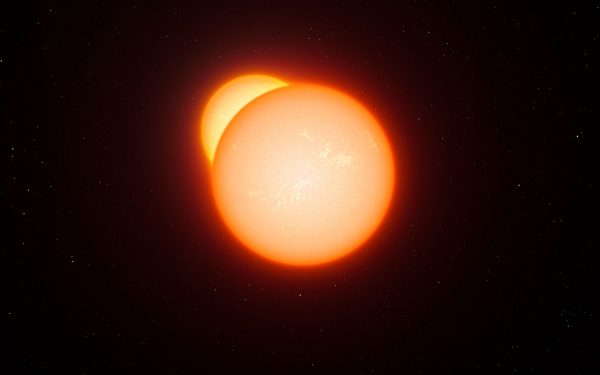
“Yes,” Peter said and pointed. “If not for that second light, the illusion would be perfect.” Beside the sun was its yellow dwarf companion star.

Peter leaned over the rail as Jeninne’s gimbaled sensor whirled to look up. “Did Julia leave? I asked her to wait.”

“She took the geo-rover up the ridge.” Jeninne extended a pruning hook to the horizon. “She said that area tested radioactive. We don’t have feed materials, and the fabricator needs heavy metals.”

“I’d planned for us to scout that area together, but I know she’s been anxious. Any predators about?”

“There’s a man-sized moa-velociraptor-thing stalking the compound. I’ve only seen one, but there could be others. So far it’s kept to the forest. I’m more concerned about that pack of six-legged predators. Two dozen were sniffing the perimeter last night and pooping. They stayed out of the light. Each must weigh about fifty kilos. Julia calls them devil-dogs. They’ve got some vicious fangs and claws. If they go after her on the ridge, she has the laser stun gun, but it only gets three shots to a charge. Until we know what they’re after, I don’t want Chloe running loose.”

Hearing her name, Chloe barked. She was the only live member of the crew. The Yellow Labrador Retriever would soon be the mother of their first children. The nano-implants had already corrected Chloe’s cryo-damage and reset her gestation time.

Jeninne’s lenses swiveled back to Peter on the deck. “Need help with Chloe?”

“No, but would you unhook her tether?”

Peter called, “Chloe, come.” The big, yellow dog bounded up the ramp and, without slowing, made a hard left into the lander’s open bay.

“I don’t imagine Julia’s rover will attract any devil-dogs,” Peter said, “not for food anyway, but they might defend their territory.”

“I’ll try not to worry,” Jeninne said, rotating on her ball-base and rolling to the garden. “I’m testing the seeds we brought from Earth along with some local tubers and seed cases, also a few fern fruits and fungi for possible medicinal applications.”

The base station lab resembled a twenty-first-century, camper trailer kitchen. Peter lifted Chloe onto the white, MechMed counter. He stroked her ears, checked her pulse and breathing, then inserted the anesthesia needle.

He took a rack with four embryo tubes from the incubator, placed one tube in the MechMed, and hit scan. The timer bar glowed soft blue, ninety seconds, eighty-nine, eighty-eight.

Peter pressed the queuing button beside the comm switches above the examination counter. His preferences flashed by—Bach, Beethoven, Dvorak, Sibelius—as they had every morning for the past seven days. He liked starting the workday with the final movements of Beethoven’s Ninth Symphony, “The Choral” in D Minor, Op. 125.

A bell chimed once and the panel beside the timer bar flashed CLEAR in soft blue. Peter removed and examined the tube, restored it to the rack, and placed a second tube in the scanner. He hummed then whistled along with the music. This time, after ninety seconds, the bell chimed three times rapidly. The panel flashed ERROR 0.07% alternating with CORRECT? Peter touched the panel. A fraction of a second later a single bell chimed and CLEAR displayed. Quantum deterioration could be expected after so long a time, even near absolute zero. He removed the second tube, switched it, and placed a third into the MechMed.

When the “Ode to Joy” began, Peter sang along, Freude, schöner Götterfunken. He had sung in the chorus at Swarthmore and felt a familiar thrill rising. Suddenly, from the open hatchway behind him, he heard the sound of a melodious flute accompanying him.

“Wonderful, Jeninne, how are you doing that?” A bell chimed and CLEAR displayed. As he removed the third tube, Peter continued singing.

The flute accompanied the melody flawlessly.

“Magnificent,” Peter said, turning to the hatchway. “How do—”

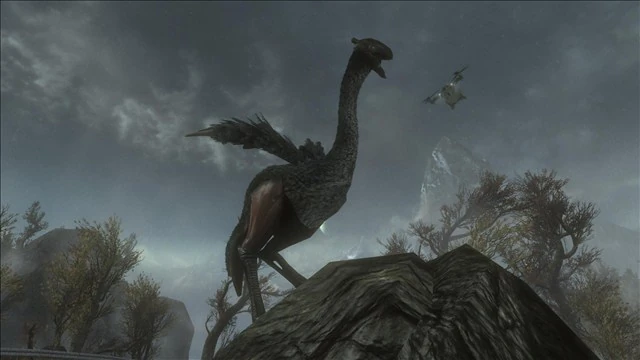
A six-foot, bird-like creature blocked his exit. The creature rocked on its powerful haunches, its black tongue vibrating in its hooked beak like a silver flute. At the end of the musical phrase, the creature lowered and widened its horn-ridged, purple eyes, and centered its beak on Peter’s chest.

He stumbled back against the counter almost dropping the embryo tube. Without thinking, words tumbled from his mouth.

“That … that … that was pretty good … you just do the classics?”

The creature folded its scale-like feathers and opened its beak. “All I hear,” it said in a chime-like voice. “Come for know.”

Peter pulled erect. “You speak English?”

Leal dipped his beak. “Music better.”
Invaders from Space, Part 1

“Ski’i,” Leal cawed to the clan council as he entered the cane forest clearing. Curls of sparks and flame twisted high into the clear night sky above the council fire. Seven warriors returned, “Ski’i,” and dipped their beaks. Firelight flickered off their ridged brows and beaks and set shadows dancing against the forest gloom.

The clan elder swept a wing to the spot beside him. Leal fluttered and folded his wings then rocked down upon the bare ground. It was the place of honor he had earned for driving the Jab-Ron clan from their land.

Leal leaned toward the fire to relieve the night chill. The scent of burning cane and spicy Chen Doe root stirred his nostrils. The incense bound all warriors to speak only the truth in council.

No females came to the fire this night for it was brooding season, and many warriors bore the scars and torn feathers from having been driven from their nests. One of the clan elder’s wings hung limp. The warrior beyond him reflected shining bald spots in the firelight. Leal displayed the short feathers and stubble on his right wing proudly, for his mate was strong and fierce. Ree had also given him a deep gash with her beak that left a blood crescent dried on his breast.

slide1

“Ski’i,” called another joining the circle.

“Ski’i,” returned Leal and the others, dipping their beaks. The newcomer Tarii extended his neck and pulled upright before sitting. A young buck porod squirmed in his beak, kicking and scratching with its six, sharp-clawed legs. Tarii tossed and caught the porod by its neck then gave a quick shake. He set the fresh kill before the clan elder then backed to the opposite side of the circle.

Impressive show, Leal thought. Porod are savage fighters, and this was a strong, young buck. Too bad the fledged females weren’t here to see the display: Tarii might have had his pick.

Unlike the mated warriors, Tarii’s feathers were full, combed, and unbloodied. Leal knew that next season they would not be. Last year Tarii had challenged him for the right to mate with Ree. It had been no contest, and there was no bad blood between them. Adolescent warriors were expected to strut and challenge, and Ree was as beautiful and intelligent as she was formidable.

“Brooding season goes well?” The elder counted only bobbing beaks. “Game plentiful … water flows … mates and young ones?” More bobs. “Good, then to our main concern. There has been another incursion in our realm.”

Tarii and two others pointed and bobbed three times, indicating three valleys to the southwest.

“Your sector again, Leal. Have the Jab-Ron returned?”

“Not Jab-Ron, of that I am certain. I saw their disk fall from the stars and settle on the cascade overlook as gentle as a twirling Chen Doe blossom. I also watched them set up camp.” All beaks turned toward Leal.

“How many?” the elder asked.

“Four, and they are all quite different from one another—each specialized for a different task. Some have interchangeable claws, limbs, and mouthparts. But none resembles the Jab-Ron or any of our species.” Leal said. A cane log cracked and collapsed, sending a spray of sparks arcing up from the fire. The scream of a lallow pierced the night air then ended abruptly, no doubt a night-stalking aglak had caught its dinner.

“One of the intruders stands on two legs as we do and is nearly our size. It has neither wings nor beak, and its body is made of metal. Two other creatures are also made of metal but have boxy bodies. One has six articulated legs like the web-spinning hindergoss, and spends its time roaming our hills. The other has rolling feet and claws that dig in the dirt. The only intruder of flesh is less than half our size. It has four legs and is covered with downy, tan fur like an adult porod. This one spotted me and alerted the others. It bared its fangs but did not pursue when I backed away.

“Weapons?” asked the elder.

“Only one. The roaming, hindergoss creature carries a weapon that shoots burning light. Other than that, they and their camp appear defenseless.”

“Have any porod packs attacked them?” asked the elder.

“No, but they’ve marked the camp with dung piles and scented a path for a night attack. Tracks indicate that several packs are working together. I believe they’ve held back for fear of the intruder’s sound shield.”

Sound shield?” The elder rocked and stretched its long neck and head toward Leal. “A defensive weapon? Have you seen it in operation?”

“If it is a weapon, it causes no harm to us,” Leal said. “I find myself curiously drawn to it, and that may be its true purpose—an attempt to communicate. The sound shield has structure, and I’m certain it carries coded information. I am able to replicate some of the sounds and believe I may soon be able to understand them.”

“Very interesting. Continue your investigation, Leal, and report back at the next council.”

Conclusion next week.

Good Neighbors

“Will I be issued a human chassis?” Djix pulsed.

“Your configuration will be humanoid, but clearly mark you as alien. For this mission to succeed, humans must see you as an alien. Otherwise, they will dismiss you as a hoax.”

“Alien? Isn’t this alien enough?” Djix exuded and waved a scale-lined appendage in the ammonia brine.

“Too alien,” Kalig pulsed. “Psyops was very clear on this. To get humans to cooperate, they must see us as advanced versions of themselves. In addition to studying humans, our abduction and probing missions have prepared them to accept this design.”

Kalig extended a pseudopod, inflating the end to form a bulb with two prominent blisters mounted atop a stick-limbed torso. “These blister sensors respond to electromagnetic radiation in the 450-800 terahertz range.”

“Humans will accept that?” Djix creased and pulled in like a folding accordion.

“Our research indicates very positive reactions from our captives. An older couple we examined even invited our scientists down for a Texas-style barbeque.”

“Barbeque?”

Searching for a sensitive way to put it, Kalig eventually rattled, “Humans consume organic materials.” When Djix’s folds tightened, Kalig added the rest. “Their bodies are composed of loosely adhering bags of dihydrogen monoxide solutions.”

Djix pursed a scaly dimple. “I know, I know, I have to go. You’re going to tell me I was specially selected … the only one you trust to handle this sensitive mission … my special skills—”

“I won’t twist your hooley,” Kalig interrupted. “You are expendable: the only one we could spare.” Djix’s receptors narrowed. “Despite their primitiveness, humans are extremely dangerous,” Kalig continued. “If you are to survive, you must appear not only intelligent but also frail and childlike. Humans must respect you but not fear you, especially since your message will not be welcome.”

Seeing Djix study the alien chassis, Kalig paused a beat. “After some discussion, we decided it best not to give you any reproductive organs—”

“Reproductive organs? They don’t let the robots … I mean they still … with their bodies … together—”

“Human lore abounds with stories of gods, aliens, and mythical beasts seducing, impregnating, or abducting their women. We don’t want to play into that narrative.”

Djix’s scales shuddered then contracted in resignation. “Okay. Brief me on my mission.”

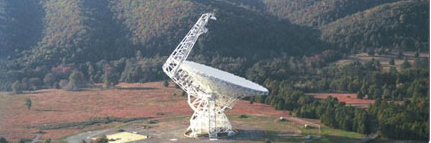
Green Bank Telescope

“You know the electromagnetic interference, the jamming that’s blocked our communication and given everyone such a core-ache.”

“The deviant pulsar emissions?”

“That’s from humans trying to make contact. They’re the ones stinking up the galaxy, spraying their e-mag pollution, trashing every frequency, begging us to come and give their life meaning. They call it their search for extraterrestrials, and they feel very smug about it.”

“Absurd,” Djix pulsed.

“Nevertheless, you’ve been selected to contact them.” Kalig paused to let Djix recalibrate. “Tell them we’ve put up with their neediness and caterwauling long enough. No one wants to contact or encourage them, and no one wants them in the galactic neighborhood. We tried to ignore them, but they just go on and on and on. The community finally got together and drew straws. We drew the short straw.”

“You mean, I drew the short straw,” Djix pulsed.

“Tell them we’re not going to solve their problems. We will not make them get along with each other or tell them how to cure cancer. If we solve their problems, they won’t get off their hind-joint sockets. The answers to all their problems are in front of them. They just need to purge their organic memory bins, stop conjuring fabulous fears, and stop worrying about who gets credit or has more of something.”

Djix oscillated so hard it almost rocked over. “I miss the ones before them, the dinosaurs.”

“A worthy species. Alas, asteroids do happen. You know, Djix, before dying out, the last thing the dinosaurs did was to restore the planet to its original condition. They dropped all their trash and technical devices into volcanoes and leveled every city. They wanted the species that came after them to have a fresh start. I’m glad they aren’t around to see this crazy bunch.”