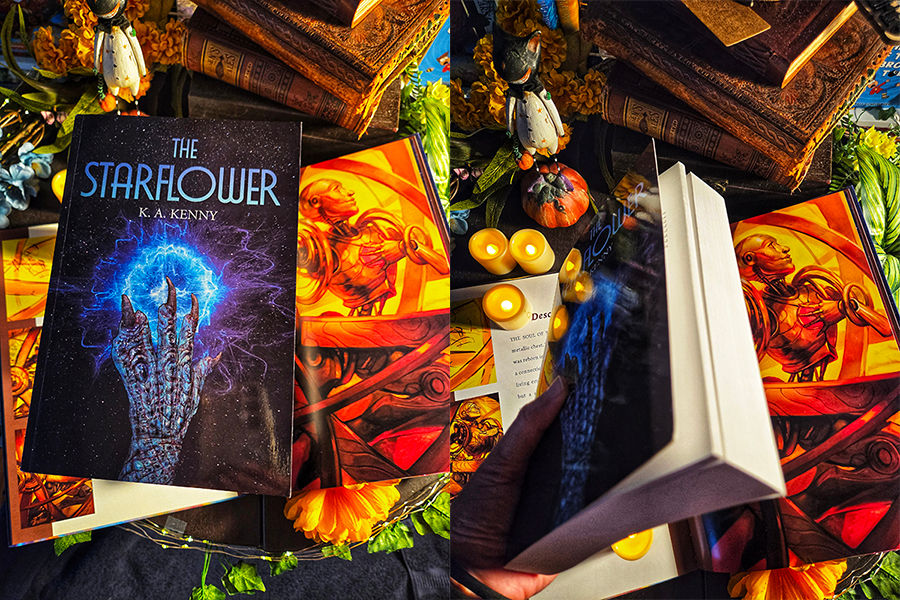
Lifelong storyteller K.A. Kenny left technical intelligence eight years ago to pursue his passion for speculative fiction. Nine of his short and flash stories have been published since 2021, and a few have also appeared in anthologies. His SF novel The Starflower came out in August 2023, and he is well into the sequel, Agent of Blue Star. K.A. is a graduate of George Mason College and has an MA in History from George Washington University. He lives with his wife Carole and dogs Cato and Mac in Virginia’s Blue Ridge Mountains.
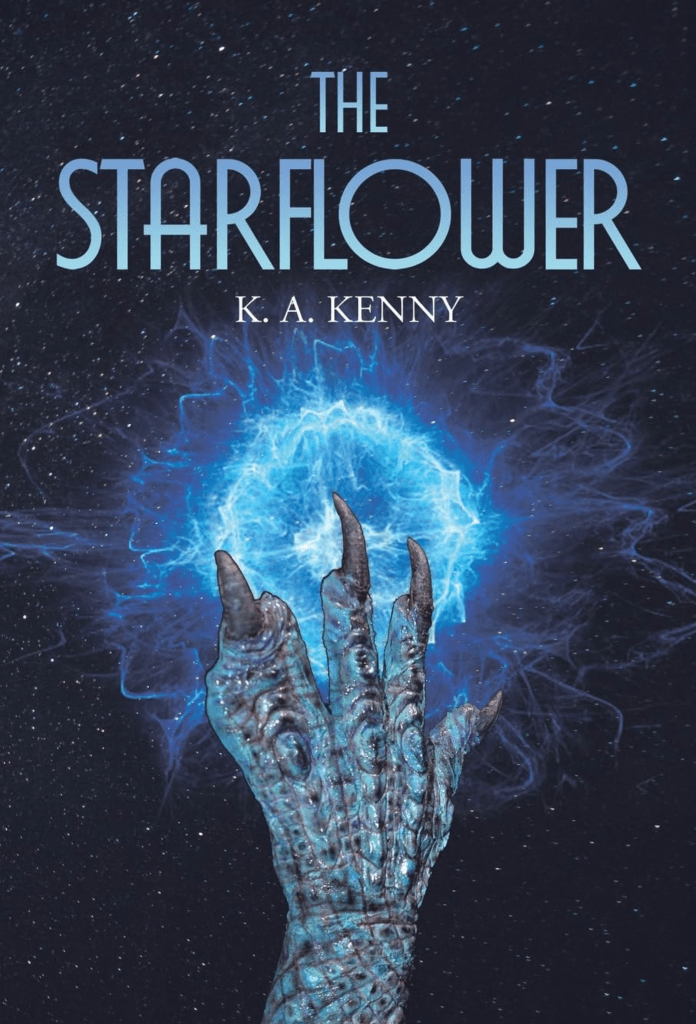
Austin Macauley Publishers informs me that The Starflower is now available in audio format on Audible, iTunes, and Amazon.
The reader learns of this far future universe and all its colorful details through the eyes of Gayle Zimmon, a young woman who grows up on a remote planet barely more aware of aliens, AI, and genetically engineered humans than she is of walking in heels. The story unfolds for the reader as it does for ‘Zim’. This week The Starflower received another 5-Star Amazon review:
January 28, 2025. The Starflower is an exciting adventure with the philosophical undertones that great science fiction is known for. Zim is a spectacular female hero. She is tough and insightful. It is a spy novel, political thriller, and futuristic fantasy, all tinged with a bit of magic (the prophecy). I hope there is a sequel. I would follow Zim anywhere!
I recorded this with Books and Author’s Fantasy and Sci-Fi Podcast by Jamie Davis about a month ago. Jamie and Scott posed some interesting questions about writing in general and how I came to write science fiction. Such as: how does technical intelligence lead one to write sci-fi?
K.A. Kenny and The Starflower on Podcast Episode 215
Lisa Haselton Book Reviews & Interviews interviewed me for THE STARFLOWER. I always enjoy these and talking about SF&F and writing, as well as other creative endeavors. Please, if anyone has any questions send them along, I’ll be happy to respond.
Readers don’t know what was cut, but writers know and may miss those they left on the cutting-room floor. And characters and scenes discarded to speed one story may have stories of their own to tell. These can return in sequels and side stories or spin off and fade like stories in our own lives. In my novel The Starflower some of my favorite untold stories are those of the alien warrior Tock.
Elder Hall – A Starflower Story
The flat, unadorned dome of Elder Hall was one of the few major structures on Tak-Yakon’s surface.
“Chirik, Ticket-Tockoket-Click. The lead elder ratcheted the traditional Chirik greeting and Tock’s full name, snapping the final click with its great claw. The other elders, one to each side of Ki-Ku-Li, tipped their triangular heads and waited as Tock centered its stick legs between the gaps of the clover-lobbed seat. These three led the Tak-Yaki military-caste. Tock was their field commander.
The one-and-a-half-meter mantids each had two serrate-jawed clamp-claws, four stick-thin walking limbs, and dark-blue carapaces that softening to violet on their undersides. Garnet-faceted eyes topped the upper corners of their triangular heads with two alert antennae between them. The mandible-mouths in the low corner of their heads stirred with finger-like pedipalps.
“Chirik, Elder Ki-Ku-Li, click-tirock.” Tock returned the greeting and tip-nodded its head to the other elders.
“Forgive our informality, Marshal Tock,” Ki-Ku-Li continued. “Before you left to assess our new Human allies, you mentioned their reputed ferocity possibly complementing our own.”
Antennae leaned forward as Tock began. “Due to their hostile natures, Humans barely survived long enough to master star travel and have made their world practically uninhabitable. After two mismanaged attempts, they successfully terraformed Corydon and relocated the Human population. Their two early attempts on Thrinlu and Scalaris continue to struggle and have progressed slowly.”
Seeing Ki-Ku-Li’s pedipalps fret, Tock jumped ahead. “To speed Human survival and recovery from war damage, the leaders of Corydon’s Star Council initiated a eugenics program, including selective breeding and genetic manipulation. Those selected they called Creatives. Those discarded, the Unders, they consigned to the less favored worlds Scalaris and Thrinlu.”
The antennae of the elder to Tock’s right pulled in. “Not unprecedented for a struggling species. I recall how our Tak-Yaki program reset our social order.”
“And it has with Humans, too.” Tock continued. “As a guide for genetic selection, Humans run annual competitions, combat trials they call the Corydon games or Corydonics, recalling games from ancient Human history. The first-place winner was to receive the Corydon Star and priority selection in the gene pool.
“Due to the combative nature of the Humans’ games I was keen to observe them, and the Star Council invited me to join them in their judging booth.”
Ki-Ku-Li stroked the underside of its mandible mouth with a massive claw. “Before going into detail, did you find any surprises?”
“Although Humans are more elusive and contrived than we Tak-Yaki, aspects of their games reminded me of our Daka-Rye drills. That could play well in our alliance, but that was not my major surprise.”
Antennae angled forward and garnet eyes gleamed atop the three elders’ heads.
“Star Council’s plan was to populate Corydon with the improved Humans then expand to other terraformed worlds. None expected discarded Unders to challenge engineered Creatives, so Star Council extended invitations to all Humans, including those on Thrinlu and Scalaris.”
Tock extended a claw absently to stroke a bent antenna. “When two Unders accepted the invitation for Scalaris, they drew immediate attention. Expecting the upstarts to die or be eliminated in the first round, Star Council took no action. But the couple won not only the first round but the entire competition with Gayle Zimmon receiving the high individual score.
“As the Corydon Star was intended to recognize the top Creative, Star Council refused to award it to an Under. Instead, they gave her a one-time medal styled on a weed native to Scalaris, a Starflower. They intended the medal as an insult, but Zimmon accepted her award gracefully.”
Ki-Ku-Li rolled its wide, flat claws out. “This Human shows character, but why have you brought her story to Elder Hall?”
“The Aldrakin War broke out shortly after the games, and we and the Humans became allies. As winner of that year’s combat games, Gayle Zimmon was called up and entered basic as a top officer candidate. Other top candidates included many she had just defeated in the Corydonics. It didn’t go well. When they attacked her, she put one in the infirmary. As a visiting ally, I witnessed the assault. Zimmon showed controlled restraint and could have killed her attacker. But that wasn’t how the military commander saw it. At the reception that evening, Zimmon’s training squadron assigned her the call sign Starflower, continuing their insult.”
“And you brought this to Elder Hall, why?” Ki-Ku-Li asked again.
“When Star Council’s Chief Military Officer Abramyan was uncertain how to proceed, I recommended that our alliance would benefit from a liaison officer, someone to learn Tak-Yaki war methods and orchestrate blended actions. If details could be worked out, Gayle Zimmon might complete her basic training with us on Tak-Yakon. Abramyan leaped at the opportunity to clear his claws of his troublemaker. Human media has been obsessed with ‘the Starflower’ ever since the combat games, and he wants to rid himself of the distraction.”
The elders’ heads rocked up as Tock concluded. “I’m impressed with this Human and see great possibilities in this exchange. However, we have never included an alien species in our military training. I need your go-ahead to proceed.”
I enjoy interviews (hint to any readers in that business) and had fun working with Xanadu Book Awards & Press. Their approach concentrates on a writer’s motivation and personal resources. To my experience, writers can be very different. Especially creative writers who think outside the formula.
I am often asked how a technical analyst (42 years in intelligence) came to write speculative fiction, and sci-fi in particular. I touch on this in the blog description: “More truth is said in fiction.” And watching a Jack Reacher movie a few months ago, I heard a similar comment from a defector: “Fiction has to make sense, intelligence does not.”
Many authors have chosen to couch serious societal comments in fantasy and fiction worlds. Mary Shelley’s Frankenstein expressed concern that scientists caught up in research would fail to consider its consequences. Kurt Vonnegut’s Cat’s Cradle expressed similar concern, and Player Piano projected an automated world that crowded out human labor. In Gulliver’s Travels, Jonathan Swift casts his societal satire in fantasy/SF worlds of miniature humans, giants, intelligent horses, and detached intellectuals floating about in a city in the sky. Consider Orwell’s Nineteen Eighty-Four and Animal Farm, both of which had trouble finding publishers because, as he was told, Joseph Stalin might be offended.
These and similar stories might be read for light escapism. The authors understood that in their time many were not ready to grasp their stories’ deeper implications. I suggest that their choice of fantasy and SF settings has much to do with these stories still being read today.
A Five Star Review of The Starflower, 13 September, 2024.
This was a vibrant story about the universe in the distant future…I believe a year that was mentioned was 3569 but that was at least a few years before this story takes place. A young military woman, The Starflower, became a hero to humans and many other alien species alike after numerous successful battles against the Aldrakin species that was waging war on many planets unable to fend for themselves. After a surprise attack that she strategically won subsequently ending the war, she is faced with jealousy from the Star Command back home. She may have ended the war, but the true enemy was still at large and had it’s targets set on her and her lover.
I was a little confused at the start of the book because it drops you straight into an immersive new world. I was able to easily find my way out of that confusion within the first few chapters and really got drawn into the story. The author was really able to make you imagine how these new worlds and alien species look and act. I found it absolutely fascinating. This is the best sci-fi book I’ve read in a while. Also as an editor I found very few errors so it was a nice clean read I could enjoy.
The war has ended, but not the way Star Commanded wanted. They are not happy. An excerpt from The Starflower.
Malik flipped through the headlines without speaking. Her office was perfect for interrogation: austere, snow-white, windowless walls, angular, black-upholstered furniture. Glare from the overhead burned Abramyan’s eyes. Despite his formal uniform and sweat-beaded face, he felt naked and cold. He knew what Malik would ask, and he had no answer.
“How did you let this happen?” she shouted, throwing up her arms. “You told me Zimmon would never be put in any combat zone. Sidelined, you said.”
Her gnarled, brown-mottled finger poked from her black sleeve at the projection. WAR ENDS – STARFLOWER VICTORIOUS! She flicked to the next headline: STARFLOWER ENDS WAR! Then the next: STARFLOWER BLOOMS! “Who authorized Zimmon to end the war?” Malik’s robe flared like an angry cobra hood.
“And this, AAAArrr.” She raked skeletal palms down her face then pulled up the next projection. The classified transmission indicated that, without authorization, military units had gone on alert and prepared to head to Bai-Yota in support of Five Squadron. “Our battle fleet supported her,” Malik screamed. “We were very, very lucky this didn’t go further.”
Abramyan had read the traffic. Each condemnation came like a twisting spear thrust. Jen Djada, the only other Councilor in the room, sat quietly by the door.
Malik spoke to Abramyan’s stone silence. “What’s next you ask?”
Abramyan couldn’t help blurting, “Lord Malik, Bai-Yota was a surprise. I didn’t, Zimmon didn’t, HELL, the Aldrakin didn’t know. They thought they’d catch us—”
“Excuses? Now you make excuses?” Malik gripped the edge of her desk with shaking, predator talons. “I’ll tell you what’s next. We get rid of her. That’s all, just get rid of her. We do it clean, we do it quiet, but we get rid of her. Soon as she reaches Corydon, you know those Under-lovers will be all over her…and Creatives, a lot of Creatives see her as some sort of righteous underdog.”
Abramyan trembled like a child caught in a snowstorm. Behind him, Djada’s jaws flexed.
Malik blew a long breath. “We can’t afford an uprising. Not now, not this close. Some of us are already in transition.” She examined her cadaverous hand then pointed toward Djada. “You still have contacts with the Rii-Chaut? They hate us but love our money.”
“I’ll tell the Yazza Hetman we have more business for him.” Djada’s self-assured demeanor unnerved Abramyan. “Ojai Khan staged the incidents that started the war. He can be discreet. When do you want it to happen?”
“Ojai Khan, yes, that went well.” Malik clapped her hands silently then pointed. “And when you see Khan, tell him I’m angry about the Silkani raid. That base was off limits. We say where to and where not to attack.” Djada gave a leaning bow from her chair.“As to the when question. Don’t have Khan kill Zimmon too soon. That would raise suspicion. We don’t want to make this little Starflower girl into a martyr.” She tapped a finger on the desk. “Let’s be positive. Unders love the Starflower. We love the Starflower, too.
Not all the reviews have been five-star, which is understandable in an epic story that lays out an entirely new universe. And some readers prefer cozy, warm stories. Zim preferred that sort of life, too. She didn’t get it.
The overarching themes of this book are somewhat reminiscent of Gattaca (in its take on Eugenics and how it might affect human hierarchy) and also of Dune (in its prophetic ideas of a single person to unite and fight for the less fortunate). Nevertheless, this story takes a unique approach to both of these themes. The main character “Zim” (callsign “StarFlower”) is both endearing and realistic. She is thrust into a prophecy when she least expects it, and all that ensues is both exciting and terrifying. The characters are very enjoyable in their depth, and I enjoyed the vast universe that the author creates. I like the combination of good story telling with so much to unpack that it will surely be a great series!
On advice from AME (Author Marketing Experts), I’ve upgraded and am revising my blog Strange Things Done to reflect longer works, beginning with The Starflower published last year. In addition to strange and speculative short fiction and non-fiction—the original purpose for STD—it will include reviews, excerpts, and discussions of my longer work and speculative discussions in general. The site may now also be reached at https://thestarflower.com.
Vanessa Bettencourt recently reviewed The Starflower for THE VIOLET WEST Fantasy Novels & Graphic Novels.
My short story “Aliens Among Us” will appear in the animal story anthology THE DOG WHO WOOED THE WORLD to be published on 30 May. My point in the story is that sentient ‘alien’ intelligence surrounds us on this planet. My story includes three real alien encounters.




 Strange Things Done